Reckoner
You can't take it with yer
Dancing for your pleasure
You are not to blame for
Bittersweet distractor
Dare not speak it's name
Dedicated to all human beings
Because we separate like ripples on a blank shore
In rainbows
Because we separate like ripples on a blank shoree
Reckoner
Take me with yer
Dedicated to all human beings
Showing posts with label devil. Show all posts
Showing posts with label devil. Show all posts
10.21.2010
The Devil - "Reckoner" by Radiohead


6.14.2010
Aesop's Fables - The Devil

By picking apart perfectly conventional behavior and making a case for how irrational or illogical it seems, the satyr here plays his role as trickster archetype to a tee. It's just a shame that his offer of food and shelter turns out to be nothing but a game to play with desperate, unwitting humans, right?
But ultimately it's our job, not the trickster's, to tie up the loose ends in our nature, to reason and rationalize. He points out our silliness, and we decide whether it's something to be corrected, embraced, or ignored. If we accept his handiwork at face-value, we just get outraged and completely miss the point.
I thought about this after watching Lars Von Trier's most recent film, Antichrist. (It's still not available on dvd in the US, but you can watch instantly on Netflix!) Maybe you heard the spoilers that were freely circulated about the film's sensational moments of sexual violence? Just in case, I won't repeat them here.
Von Trier is a provocateur, but he isn't the kind of manipulator who yanks one way in order to force the audience to yank back in the other. There are no easy answers to the questions he raises, there is no "right" reaction. As a culture we too often prefer for our artists to do all the thinking for us; we've been trained to respond poorly to narratives which are open-ended or which refuse to fully resolve the emotional disturbances they trigger. We don't mind being directed to examine our own dark side as long as we're already pretty sure what we'll see there, and we hate (HATE) the idea of some smug jerk out there reveling in his moral or intellectual superiority.
One of my favorite interpretations of Antichrist is that it's a response from Von Trier to those who have accused him of misogyny based on films such as Dogville and Dancer in the Dark. The heroine of Antichrist, played by Charlotte Gainsbourg, reveals to her husband that she believes women are inherently evil. By introducing an openly misogynist female character -- who may or may not be a mouthpiece for the director's own ideas -- Von Trier demonstrates his awareness of the debate already in progress, and adds considerable depth to it, all without insulting our intelligence with any platitudes or pat answers.
It's just like what wicked queen Sigourney Weaver says at the end of Snow White: A Tale of Terror when young miss thing accused her of having no heart: "That's too simple." Hate her, Von Trier, or any other morally-ambivalent trickster all you like, but she's got that part right.

10.26.2009
"I Was Thinking With My Tongue..."

This is the sixth installment in a series of short essays inspired by the 22 Trump cards, featuring original artwork by Greg Erskine (Click and scroll down for large version).
I’m not really into favorites. I don’t have a favorite color, or a favorite book, or a favorite flavor of ice cream. Not only does it make me hard to shop for, it makes filling out forms on social networking sites like Facebook really nerve-wracking. Would-be friends and lovers are impatiently waiting to judge me purely on what I write in the box -- but do I really prefer Björk’s “Medúlla” album to Meat Loaf’s “Bat Out of Hell”? Can I really say with authority that the The Elephant Man is a better movie than, say, Easter Parade? Perhaps the only solution is to enjoy them simultaneously:
Anyhow, I didn’t exactly recognize the special feeling creeping up on me this summer until it was actively rotting my teeth. I was waiting for a bus and had gotten about halfway through a bag of Haribo Fruit Salad, savoring tiny, sugar-encrusted bites of what I think is supposed to represent a wedge of grapefruit, when I caught myself thinking the actual words, My god, I am so gloriously happy right now. Silly, isn’t it, for a grown man to let a piece of candy toy with his emotions? But I had to face facts. This was no mere dalliance -- this was my third bag of Fruit Salad in as many days. I turned the bright yellow bag over in my hands, appraising it. It's a miracle of visual marketing -- the bag robustly and cheerfully provides in full everything that it promises. The gummi fruit pieces are every bit as fresh ‘n fruity n’ chewy as advertised. "Kids and Grown-ups Love It So,” the bag declares with modest pride, as if to say, "We don't think we're anything special -- but apparently the public has spoken." Of course, the slogan applies to the entire world of Haribo products, but I’m tempted to believe that Fruit Salad deserves a greater share of the credit than the Fizzy Cola bottles, or those insipid Build-a-Burgers. And to top it all off, the shit is fat free.
“My god,” I said, out loud so that all of my fellow commuters could bear witness, “This is my favorite candy. I have a favorite candy.”
Let me count the ways. Six fruits are represented, each a clear note that can be played independently or harmonized to form a spectral chorus. Cherry. Lemon. Orange. The glorious grapefruit. That whitish one which I think is meant to be a peach. And my favorite of all: the green thing. Is it meant to be lime? Sour apple? Unimportant. I try to eat them in a specific order every time, product quality-control permitting, beginning with my least favorite (cherry) and working toward a climax that finishes with the green thing. By the time the symphony ends, I’m no longer thinking rationally. I begin it all over again, intent on repeating the cycle until there’s nothing left in the bag but a quarter inch of loose sugar grains.
How did these Haribo geniuses do it? Whatever the “natural flavors” consist of, they’re more complex than your average penny-candy fruit wedges by several orders of magnitude. And Fruit Salad doubles as a unique mouthfeel experience -- each fruit is a different shape that tends to vary in density and chewiness, even within the same bag. Some pieces are as tender as your own tongue, the sugared rinds barely containing their melty contents. Other pieces seem to have toughened a bit on the vine, forcing your mouth to disrobe them in layers. I've always thought of myself as too much of a candy-lover to ever bed down with just one treat -- I want it all, from the deepest dark chocolate to the foamy orange Circus Peanuts. But the sheer variety that exists within a single bag of Fruit Salad hits enough receptors at once that I am tricked into complacency. It allowed me feel as if, at long last, I could experience commitment without compromise.
But as all flowers necessarily have their roots in the dark earth, each love affair contains its own built-in tragedy. Having become downright evangelical about the happy world of Haribo, sharing my Fruit Salad with pretty much anyone I talked to for more than five minutes, I decided it was time to partner up -- I would contact the company and see if they were interested in advertising on my website. (I recognize that Tarot is not a subject that necessarily lends itself to a promotional candy tie-in, but I figured a large Japanese company might be oblivious to those details. I was thinking with my tongue.)
So I trotted over to their happy online directory to see whom I should contact about writing “HARIBO” on my site in big chewy letters, and while searching for a contact form, I strolled into the FAQ to learn a little more about their diverse range of products -- valuable, I thought, on the off-chance that I wound up actually talking to a corporate representative. Most of the queries were rather whimsical, such as “Can I buy just one flavor of Haribo Gold-Bears?” (The answer: No. “We recommend finding some friends who like the other colors and trading with them!”) Then I spied this fairly innocuous question: “What type of gelatin does Haribo use?” I hesitated. I figured I probably oughtn't examine my favorite candy too closely. But since I am only human, I couldn't help plucking the gummi apple from the Tree of Knowledge. The answer: “Haribo products produced in Haribo's factory in Turkey are made with beef gelatin and are certified HALAL. All other items are made with pork gelatin.”
English is a funny language. Out of context, the word “gelatin” is sort of elegant, really. When you read it, you imagine blameless, pellucid cubes on a conveyor belt, blank slates quivering in anticipation as they wait to be imbued with magical, “natural” flavors. It looks so nondescript on a list: blah blah, Corn Syrup, Gelatin, Citric Acid, Fumaric Acid, blah blah. In the murderer’s row of common candy ingredients, the presence of gelatin is downright comforting.
“Pork gelatin”, unfortunately, is evocative in an entirely different way. It conjures aromatic images of skins and skeletons, scalding water and enzyme solvents. Cauldrons. Industrial fumes. Living flesh particles that have been mechanically and chemically broken down -- digested -- beyond recognition. “Gelatin” has a certain mystique, but "Pork Gelatin" hides nothing, it fails to transcend the sum of its eye-watering ingredients. In my case, anyhow, it was a grim reminder of the absolute nadir of the industrial food chain. On one end of the miles-long conveyer belt, a factory-farmed pig who has never known the essential pleasures of real dirt underfoot or sun on its skin, who was probably raised on a diet of meat-byproducts deemed unfit for even gelatin-production. On the other end, mouthwatering fruit shapes cascade into merry little bags. The deception is downright insidious.
As I sat there marinating in my distaste, I couldn’t resist being amused by another question on the page, about Haribo factory tours: “All 18 Haribo factories are located in Europe. Unfortunately they do not offer tours to the public.” Well, I thought, I should think not.
I’m not what you would call a vegetarian or an animal rights activist. I spent a lot of time on my grandparents' cattle ranch as a child, and I remember standing by and watching as calves became steers, their freshly harvested testicles deposited in the crusty coffee-can which had been nailed to a nearby fence-post for this very purpose. There were days when red-hot branding irons perfumed the fresh air with the essence of burning skin, but it somehow never kept me from enjoying my share of that night's beef stew.
However, my grandparents and their range-fed animals belong to another agricultural era, and now I'm very selective about which animal products I consume, and how they were produced. And so this revelation made me feel deeply conflicted. Additionally, I felt stupid for having been too blinded by my sugar-high to have put two and two together on my own. Given my upbringing, my denial was embarrassingly naive -- where on earth had I thought that the 7% of my daily protein-value per bag was coming from, anyway? The Yellow No. 5? My dairy- and nut-free favorite candy has a protein-value. How gross is that?
I was also disturbed by my own hypocrisy. As a consumer, shouldn't I be happy that these by-products weren't going to waste? If I'm to enjoy the occasional no-questions-asked hot pastrami sandwich, isn't it fitting to abase myself by occasionally dining on the sludge at the bottom of the barrel as well? Was I horrified by the ingredient and all it stood for, or was I horrified because I literally could not get enough of it? The idea of having gained and lost a favorite candy seemed more painful to me than never having had one at all. Had my access to that happy world of fresh ’n fruity ’n chewy pleasure been permanently barred? Would I settle for a Fruit Salad-free world -- or even worse, one of guilty, ironic indulgence?
The answer to that last question has turned out to be, predictably, both yes and no. After a week or so hiatus, during which I drowned my sorrows in Toblerone, I bought another bag of Fruit Salad. Its 26 grams of sugar per-serving (and 2 grams of protein) tasted just as good to me as ever. Better, even -- I’d missed each flavor like a friend. There is an incredible amount of cognitive dissonance to overcome in enjoying any heavily-processed food, but the miraculous transformation of hog-ankle stew into a sparkling, lip-smacking delicacy (named, in a master stroke of evil genius, after a much healthier snack) continues to short-circuit my brain. I don’t just eat the fruit slices -- I savor them. I take little bites to make them last longer, I cut them open with my teeth and turn them inside-out so that I can plunder their slick gummi insides. I want to come back to Earth and its harsh realities, its inferior candies. I want to think of the stench of the pit that wrought these gems, but their power over me is too strong. Am lost in the happy world of Haribo. Please send help.

5.26.2009
2.23.2009
"How Easily Falsehoods and Errors Become Accepted as Truth..."

The personal confusion and torment that we feel in our lives is almost always the product of illusions that we have subscribed to -- we have an unfortunate tendency to forget which parts of ourselves are real and which parts were merely imprinted on us by others, or which parts we adopted out of curiosity or convenience. Over time it all becomes "real" to us. Some of these illusions are so beautiful that we become angry when they're threatened; some of them we are desperate to shed at all costs, but they are too deeply embedded within us.
In the context of the Devil card, it's important to understand that the pretenses you are operating under may be completely false. Realizing this may change your mind about what to do next, or it may not -- sometimes we have to maneuver within the world we currently occupy, even we know it's not quite legit. However, it's still important to leave yourself reminders along the way that this is all just a game that you're playing. Set your hopes, fears, and expectations accordingly, and try not to fall too hard for any of your own tricks.
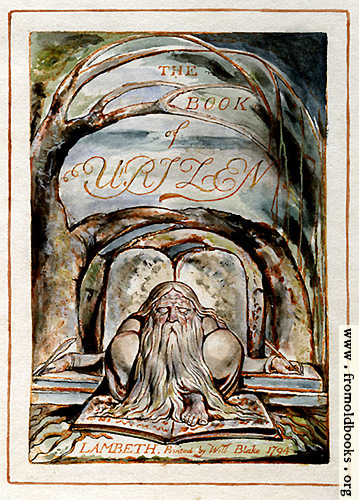
This is a personal problem that we all experience, but it's also a sociological problem that we perpetuate. Thanks to the inherent corruption he observed in the Church of England, poet William Blake became so soured on the concept or religion that in 1794 he published his own beautifully illustrated creation myth, The Book of Urizen. In the story, Urizen is one of the glorious immortal beings occupying the vastness of eternity; unsatisfied with the airy-fairy way in which the Eternals live, love, and worship their creator, Urizen decides they'd all be better off if the terms of their world were made concrete. He forges a heavy book made of iron, inscribed with "laws of Peace, of Love, of Unity," in hopes that all the Eternals can live together under the umbrella of "one King, one God, one Law."
As noble as his intentions are, the other Eternals are horrified by his attempt to whittle their boundless world down to such a narrow point; a vast dualism is created as they recoil from Urizen and his metal book, and in that sudden vacuum his reductive philosophy triggers a chain reaction that creates our world, a world in which eternal concepts and intangible ideas become ironclad, trapped in the manacles of physical matter. Urizen himself goes through this transformation, quite painfully so. His new form eventually becomes our own, as the world he's created becomes peopled by creatures who are born into the slavery of their God/Father and his metal book.
Blake wanted people to question the ideas that they'd been grown up accepting as "normal," to see how easily falsehoods and errors become accepted as truth if they are all people were ever taught, and how these falsehoods could wind up enduring for centuries. He believed that over time the biblical version of Christianity had gradually eclipsed individuals' own religious experiences, keeping them from ever forming a unique and personal relationship with God. In Blake's deeply pious opinion, the Bible had evolved into a "book of error," and the Church's dogmatic adherence to it practically guaranteed that few would ever glean any real comfort, love, or insight from their religion.
The irony of this statement being made by a professional book-maker was not lost on Blake; he didn't see himself as being immune to the inevitable errors of forcing intangible ideas into physical, readable, durable forms. But as a poet he was able to explore this concept on many levels, and always tried to impress upon his readers that we each have our own link to God that defies human reason, despite what any priest or book might say, and that any attempt to confineor define Him would result in errors that could result in terrible human suffering.
In The Marriage of Heaven and Hell, Blake created a new body of divine wisdom, called "Proverbs of Hell," which contained "blasphemous" truths attempting to correct false impressions cultivated by the Church:
"The pride of the peacock is the glory of God.
The lust of the goat is the bounty of God.
The wrath of the lion is the wisdom of God.
The nakedness of woman is the work of God."
Below are a few verses from The Book of Urizen which describe the doomed Eternal's descent into matter, "the changes of Urizen." This process is meant as a parallel to the gestation of a human infant in the womb. As he slumbers, the world is forged around him by his prophet, Los, until the 5th stanza when Urizen's own body slowly begins to take form:
"1. Ages on ages roll'd over him!
In stony sleep ages roll'd over him!
Like a dark waste stretching chang'able
By earthquakes riv'n, belching sullen fires
On ages roll'd ages in ghastly
Sick torment; around him in whirlwinds
Of darkness the eternal Prophet howl'd
Beating still on his rivets of iron
Pouring sodor of iron; dividing
The horrible night into watches.
2. And Urizen (so his eternal name)
His prolific delight obscurd more & more
In dark secresy hiding in surgeing
Sulphureous fluid his phantasies.
The Eternal Prophet heavd the dark bellows,
And turn'd restless the tongs; and the hammer
Incessant beat; forging chains new & new
Numb'ring with links. hours, days & years
3. The eternal mind bounded began to roll
Eddies of wrath ceaseless round & round,
And the sulphureous foam surgeing thick
Settled, a lake, bright, & shining clear:
White as the snow on the mountains cold.
4. Forgetfulness, dumbness, necessity!
In chains of the mind locked up,
Like fetters of ice shrinking together
Disorganiz'd, rent from Eternity,
Los beat on his fetters of iron;
And heated his furnaces & pour'd
Iron sodor and sodor of brass
5. Restless turnd the immortal inchain'd
Heaving dolorous! anguish'd! unbearable
Till a roof shaggy wild inclos'd
In an orb, his fountain of thought.
6. In a horrible dreamful slumber;
Like the linked infernal chain;
A vast Spine writh'd in torment
Upon the winds; shooting pain'd
Ribs, like a bending cavern
And bones of solidness, froze
Over all his nerves of joy.
And a first Age passed over,
And a state of dismal woe.
7. From the caverns of his jointed Spine,
Down sunk with fright a red
Round globe hot burning deep
Deep down into the Abyss:
Panting: Conglobing, Trembling
Shooting out ten thousand branches
Around his solid bones.
And a second Age passed over,
And a state of dismal woe.
8. In harrowing fear rolling round;
His nervous brain shot branches
Round the branches of his heart.
On high into two little orbs
And fixed in two little caves
Hiding carefully from the wind,
His Eyes beheld the deep,
And a third Age passed over:
And a state of dismal woe.
9. The pangs of hope began,
In heavy pain striving, struggling.
Two Ears in close volutions.
From beneath his orbs of vision
Shot spiring out and petrified
As they grew. And a fourth Age passed
And a state of dismal woe.
10. In ghastly torment sick;
Hanging upon the wind;
Two Nostrils bent down to the deep.
And a fifth Age passed over;
And a state of dismal woe.
11. In ghastly torment sick;
Within his ribs bloated round,
A craving Hungry Cavern;
Thence arose his channeld Throat,
And like a red flame a Tongue
Of thirst & of hunger appeard.
And a sixth Age passed over:
And a state of dismal woe.
12. Enraged & stifled with torment
He threw his right Arm to the north
His left Arm to the south
Shooting out in anguish deep,
And his Feet stampd the nether Abyss
In trembling & howling & dismay.
And a seventh Age passed over:
And a state of dismal woe."
6.17.2008
THE DEVIL

Illustrator Boris Artzybasheff packed his artwork with sensuous, beguiling distortions of the human animus. In these galleries you'll glimpse oddities that mirror and mock our whims and desires with an unrelenting accuracy-- perfect for the Devil card!
Though it's another of those that tends to inspire dread during readings, The Devil represents a natural phase of humanity just like all the other cards... so no need to keep crossing yourself. Remember, just as diagnosis is the first step toward recovery from disease, seeing dangerous illusions for what they are is the first step to being able to see past them. When people say "better the devil you know than the devil you don't," this is what they mean.
"What if this life is all there is?" The Devil asks. If there's nothing else to look forward to, suddenly the utmost importance is placed on our time in this world, and we begin bargaining with ourselves (and with each other) to make sure we leave no stone in our fears and desires unturned. Regardless of your views on death or what comes after, you must surely agree that it's probably not that simple-- and yet there are times when we gladly wander into these tempting illusions, even actively weave them into our identity.
Think of carnal and material obsessions as a vast city that most of us visit (for some it's a daily commute!) and some of us even live in. The longer you stay, the more you succumb to its alluring distractions, and the harder it is to remember that there was ever anything else; the city grows and grows around you until it blots out the recollection of any other way of life. By the time it's no fun anymore, we're wandering through the maze like amnesiacs, blaming everyone else for our condition, and too weak to change ourselves back. At that point it seems easier to just wait for some immense catastrophe like an asteroid to smash the city out from under us, rather than just get up and leave. This card gently invites you to evaluate the reality that your current values have built up around you. What happens after that is up to you.
You tell yourself: I'll be gone
To some other land, some other sea,
To a city lovelier than this
Could ever have been or hoped to be--
Where every step now tightens the noose:
A heart in a body buried and out of use:
How long, how long must I be here
Confined among these dreary purlieus
Of the common mind? Wherever now I look
Black ruins of my life rise into view.
So many years have I been here
Spending and squandering, and nothing gained.
There's no new land, my friend, no
New sea; for the city will follow you,
In the same streets you'll wander endlessly,
The same mental suburbs slip from youth to age,
In the same house go white at last--
The city is a cage.
No other places, always this
Your earthly landfall, and no ship exists
To take you from yourself. Ah! don't you see
Just as you've ruined your life in this
One plot of ground, you've ruined its worth
Everywhere now-- over the whole earth?
Lawrence Durrell, Justine
Subscribe to:
Posts (Atom)