


The personal confusion and torment that we feel in our lives is almost always the product of illusions that we have subscribed to -- we have an unfortunate tendency to forget which parts of ourselves are real and which parts were merely imprinted on us by others, or which parts we adopted out of curiosity or convenience. Over time it all becomes "real" to us. Some of these illusions are so beautiful that we become angry when they're threatened; some of them we are desperate to shed at all costs, but they are too deeply embedded within us.
In the context of the Devil card, it's important to understand that the pretenses you are operating under may be completely false. Realizing this may change your mind about what to do next, or it may not -- sometimes we have to maneuver within the world we currently occupy, even we know it's not quite legit. However, it's still important to leave yourself reminders along the way that this is all just a game that you're playing. Set your hopes, fears, and expectations accordingly, and try not to fall too hard for any of your own tricks.
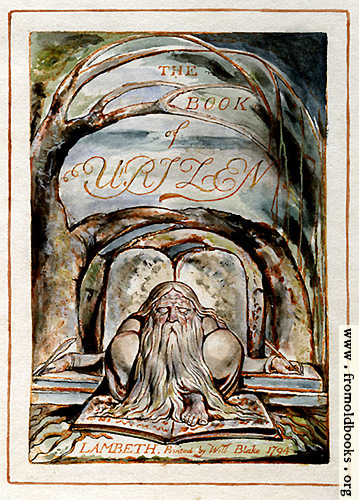
This is a personal problem that we all experience, but it's also a sociological problem that we perpetuate. Thanks to the inherent corruption he observed in the Church of England, poet William Blake became so soured on the concept or religion that in 1794 he published his own beautifully illustrated creation myth, The Book of Urizen. In the story, Urizen is one of the glorious immortal beings occupying the vastness of eternity; unsatisfied with the airy-fairy way in which the Eternals live, love, and worship their creator, Urizen decides they'd all be better off if the terms of their world were made concrete. He forges a heavy book made of iron, inscribed with "laws of Peace, of Love, of Unity," in hopes that all the Eternals can live together under the umbrella of "one King, one God, one Law."
As noble as his intentions are, the other Eternals are horrified by his attempt to whittle their boundless world down to such a narrow point; a vast dualism is created as they recoil from Urizen and his metal book, and in that sudden vacuum his reductive philosophy triggers a chain reaction that creates our world, a world in which eternal concepts and intangible ideas become ironclad, trapped in the manacles of physical matter. Urizen himself goes through this transformation, quite painfully so. His new form eventually becomes our own, as the world he's created becomes peopled by creatures who are born into the slavery of their God/Father and his metal book.
Blake wanted people to question the ideas that they'd been grown up accepting as "normal," to see how easily falsehoods and errors become accepted as truth if they are all people were ever taught, and how these falsehoods could wind up enduring for centuries. He believed that over time the biblical version of Christianity had gradually eclipsed individuals' own religious experiences, keeping them from ever forming a unique and personal relationship with God. In Blake's deeply pious opinion, the Bible had evolved into a "book of error," and the Church's dogmatic adherence to it practically guaranteed that few would ever glean any real comfort, love, or insight from their religion.
The irony of this statement being made by a professional book-maker was not lost on Blake; he didn't see himself as being immune to the inevitable errors of forcing intangible ideas into physical, readable, durable forms. But as a poet he was able to explore this concept on many levels, and always tried to impress upon his readers that we each have our own link to God that defies human reason, despite what any priest or book might say, and that any attempt to confineor define Him would result in errors that could result in terrible human suffering.
In The Marriage of Heaven and Hell, Blake created a new body of divine wisdom, called "Proverbs of Hell," which contained "blasphemous" truths attempting to correct false impressions cultivated by the Church:
"The pride of the peacock is the glory of God.
The lust of the goat is the bounty of God.
The wrath of the lion is the wisdom of God.
The nakedness of woman is the work of God."
Below are a few verses from The Book of Urizen which describe the doomed Eternal's descent into matter, "the changes of Urizen." This process is meant as a parallel to the gestation of a human infant in the womb. As he slumbers, the world is forged around him by his prophet, Los, until the 5th stanza when Urizen's own body slowly begins to take form:
"1. Ages on ages roll'd over him!
In stony sleep ages roll'd over him!
Like a dark waste stretching chang'able
By earthquakes riv'n, belching sullen fires
On ages roll'd ages in ghastly
Sick torment; around him in whirlwinds
Of darkness the eternal Prophet howl'd
Beating still on his rivets of iron
Pouring sodor of iron; dividing
The horrible night into watches.
2. And Urizen (so his eternal name)
His prolific delight obscurd more & more
In dark secresy hiding in surgeing
Sulphureous fluid his phantasies.
The Eternal Prophet heavd the dark bellows,
And turn'd restless the tongs; and the hammer
Incessant beat; forging chains new & new
Numb'ring with links. hours, days & years
3. The eternal mind bounded began to roll
Eddies of wrath ceaseless round & round,
And the sulphureous foam surgeing thick
Settled, a lake, bright, & shining clear:
White as the snow on the mountains cold.
4. Forgetfulness, dumbness, necessity!
In chains of the mind locked up,
Like fetters of ice shrinking together
Disorganiz'd, rent from Eternity,
Los beat on his fetters of iron;
And heated his furnaces & pour'd
Iron sodor and sodor of brass
5. Restless turnd the immortal inchain'd
Heaving dolorous! anguish'd! unbearable
Till a roof shaggy wild inclos'd
In an orb, his fountain of thought.
6. In a horrible dreamful slumber;
Like the linked infernal chain;
A vast Spine writh'd in torment
Upon the winds; shooting pain'd
Ribs, like a bending cavern
And bones of solidness, froze
Over all his nerves of joy.
And a first Age passed over,
And a state of dismal woe.
7. From the caverns of his jointed Spine,
Down sunk with fright a red
Round globe hot burning deep
Deep down into the Abyss:
Panting: Conglobing, Trembling
Shooting out ten thousand branches
Around his solid bones.
And a second Age passed over,
And a state of dismal woe.
8. In harrowing fear rolling round;
His nervous brain shot branches
Round the branches of his heart.
On high into two little orbs
And fixed in two little caves
Hiding carefully from the wind,
His Eyes beheld the deep,
And a third Age passed over:
And a state of dismal woe.
9. The pangs of hope began,
In heavy pain striving, struggling.
Two Ears in close volutions.
From beneath his orbs of vision
Shot spiring out and petrified
As they grew. And a fourth Age passed
And a state of dismal woe.
10. In ghastly torment sick;
Hanging upon the wind;
Two Nostrils bent down to the deep.
And a fifth Age passed over;
And a state of dismal woe.
11. In ghastly torment sick;
Within his ribs bloated round,
A craving Hungry Cavern;
Thence arose his channeld Throat,
And like a red flame a Tongue
Of thirst & of hunger appeard.
And a sixth Age passed over:
And a state of dismal woe.
12. Enraged & stifled with torment
He threw his right Arm to the north
His left Arm to the south
Shooting out in anguish deep,
And his Feet stampd the nether Abyss
In trembling & howling & dismay.
And a seventh Age passed over:
And a state of dismal woe."
2.23.2009
"How Easily Falsehoods and Errors Become Accepted as Truth..."


Subscribe to:
Post Comments (Atom)


No comments:
Post a Comment