Photobucket
Showing posts with label three. Show all posts

6.03.2010

Sketchbook - Three of Wands

Three of Wands


Whenever my family took long drives through the country during my childhood -- which was often, since we actually lived in the country -- I would gaze tirelessly out the window at the utility poles going by. They seemed like living things to me, enormous kachinas strolling across the landscape and waving at us with rigid arms as we passed. Even the simpler ones like the ones in my sketch held my fascination; stretching out as far as I could see in either direction, they created a thread of continuity across the wild desert.

The poles and the railway tracks above ultimately serve the same function: continuity and follow-through, connectivity and opportunity. They are worldwide symbols of power, evolution, and commerce. I threw in a handful of stars above to light the way, to temper the conceit that feeds off of our forward momentum, and to remind us of the true power out there that inspires but simultaneously dwarfs our own.

Our dreams often carry us forward at the expense of others. Indeed, we often even double-cross ourselves along the way, such is our ambition. You can follow the winding paths of the poles and tracks to get to the next civilized outpost; in the meantime the stars are your moral compass, by which to judge your true position in the cosmos at any given moment.


Photobucket

4.13.2010

Sketchbook - Three of Coins

Sketchbook - Three of Coins


I have had cheese on the brain ever since I bought a hunk of 2-year aged gouda at Murray's this past weekend that made my salivary glands turn positively inside out with delight. It wasn't even that expensive, maybe $6.75 for a wedge that will last all week.

So it was only a matter of time before it showed up somewhere in one of these drawings, especially since I'm always trying to find objects to stand in for Coins that aren't actually currency. Wheels of cheese have an earthy gravitas that make them perfectly fitting for use in this suit.

As for this particular card, the Three is all about the marvels that can be accomplished with a little harmonious collaboration. Some of the most satisfying fruits of our labor are also the simplest, but we often take those for granted in pursuit of our far-flung ideals. Working with others is a tempering process, and it's the surest way to keep your ego and fantasies in check.

I wanted to draw something humble that tapped into the same artisanal spirit of Pamela Coleman-Smith's version. Cheese-making is still a craft that entire families and communities devote themselves to, and I suppose you could see it as a joint effort involving humans, animals, and microbes (though realistically I'm sure a goat cares little for what you do with her milk once you've taken it).


Photobucket

3.05.2010

Sketchbook- Three of Swords

Sketchbook - Three of Swords


The Three of Swords is sort of inverse echo of the Three of Cups, in which feelings of fullness and satisfaction are seeded with awareness of the emptiness and loss that will inevitably accompany them. It's a case of runaway brain, dragging the heart behind it like a tin can.

I decided to show this with an apple which has been dealt exactly three cuts. It's been picked apart, vivisected. While it is surely still perfectly edible, something ideal has been lost; the fruit's wholeness can never be restored. The knife lingering nearby distracts us from the deliciousness of the bite, reminding us instead of the violence of the cut.

The two wedges that have been created remind me of the two falling figures in the Tower card, or Adam and Eve discovering their nakedness. They did not exist as independent entities until this moment, their division from each other and from the whole having been wrought upon them by unknowable forces. It may seem like little consolation, but each slice contains seeds from which future expressions of that original wholeness may still spring.


Photobucket

2.26.2010

Sketchbook - Three of Cups

Sketchbook - Three of Cups


O, delicate triumvirate! How the world envies your happy dancing.

I really wanted to think of something that would indicate the fullness and delicacy of this card. Here we see three conjoined soap bubbles, remaining magically intact as other bubbles burst all around them.

A wand looks on approvingly from the sidelines -- its actions may have brought them all together, but now it's perfectly superfluous. Though it does serve to remind us that expressions of openness and love are always more accessible than you think they are. There are always more where these came from, and the phenomenon never fails to enchant.


Photobucket

1.21.2010

"More Subjects, More Objects, More Love..."


When it comes to symbolic gestures, you really can't beat Ecuador's "glass frog". Since the creature lacks any pigment, you can literally see his heart beating through his chest. Awww... More awwws for this barely-there gecko, also recently unearthed. Researchers are racking up the discoveries down there, but they're still only the beginning -- National Geographic speculates that, all told, we've only identified a tiny percentage of all the world's life forms. And I bet you thought we'd more or less sorted it all out by now!

The glass frog is my hero today. I've put him at the helm of the Three of Cups because of his all-too-poetic transparency -- I ought to channel his fearlessness a little more often and let people make of my lungs and pancreas and feelings what they will. But really all these "new" animals deserve a spot on the card, because collectively they are a reminder of the life our planet is teeming with, the opportunities yet to be discovered, and the vulnerability that is universal among all life forms -- as superior as we humans consider ourselves to be, what with our chain-mail and wisecracks and neatly pressed khakis, we are not much different than a horde of pencil eraser-sized lizardettes swarming across the jungle floor.

While the love in the Two rebounds back and forth in a closed loop between two subjects, the Three invites you to open up in search of more -- more subjects, more objects, more love. It heralds a season of availability and generosity, regardless of how this jibes with your fastidious economic principles. Conserve through giving -- when it comes to emotion, ecology trumps economy every time. [Via]


Photobucket

10.02.2009

"I'll Probably Always Have These Ugly Scars..."


Jazmine Sullivan's single "Bust Your Windows" isn't exactly new -- it debuted a year ago on her album Fearless. But you know, I never really stopped listening to it. Sullivan's a true vocal heavyweight, and it's crushing to hear someone so young sing lines like "I gave you all of me, and you played with it" with utter conviction. So after playing it yet again yesterday morning, I decided I'd do a post about it connected to the perennially miserable Three of Swords.

Unfortunately I can't embed the video, you'll have to click here to listen to Sullivan's version. However, I can embed the version that Amber Riley performed this summer on the show Glee, which is also pretty impressive:


It's funny, I'd already cobbled together the card for this post when I stumbled across Riley's version -- I just happened to watch Ep. 4 last night during my campaign to find out what's up with this Glee show that all the young kids are tweetering about these days. Spooky coincidence!

In my previous posts about the Three of Swords, I mostly focused on self-harm, denial, isolation, and loss of awareness; these are extreme emotional reactions to the bitter truths we'd rather not face head-on. The damage we do isn't constrained to ourselves, however: We often lash out at the people whom we perceive (perhaps inaccurately) to be the source of our pain. Or if we're in a hurry, we'll settle for the convenience of punishing whomever happens to be readily available.

And because of the hell we've been through, we feel completely justified in our actions, no matter how appalling they are. Our emotions are important, but they can also be disorienting -- in a crisis they'll send people right off a cliff, and ourselves off right after them -- but Justice is more satisfying in the long term, and it can't exist without reason and impartiality.

That's what Sullivan touches upon at the end when she wails, "But why am I the one who's still crying?" She's busted those damnable windows, she wrote her initials with a crowbar, and now she's even confessed the whole thing. So why doesn't she feel any better, already?

If you're wise enough to see that revelation coming before you start wrecking, then you're in a better position than most to appreciate and heed this card's warning.


Photobucket

6.08.2009

"Playing An Unwinnable Game..."


"The fortune teller told me my love with you was through
I hope her reading was wrong
I hope she was wrong cause you've been gone too long
Come home. . ."

Grief is often accompanied by an odd self-awareness. "What a cliche reaction," you might think as you sniffle into your fourth wad of tissue. "How dumb of me to care this much." Other times, your feelings completely blot out all reason until they are all you have. The Shangri-Las' music seems to appeal to either situation. On one hand the girl group, who rose to fame on hits such as "Leader of the Pack", performed some of the most truly melancholy pop music of the '60s.


On the other hand, they were really just a bunch of teenagers from Queens who were making it all up as they went, thrilled simply to be in the public eye -- their tuff-girl posturing and winsome attempts at high drama were eerily successful at keeping them there for a time. They weren't particularly well-equipped to handle the rigors of fame or the cultivation of public personae, however, and ultimately ended up being a pretty tragic team. It may have been woven into the very fabric of their destiny -- Wikipedia claims that "Initially, the girls performed without a name. But when they signed their first deal, they began calling themselves the Shangri-Las, after a Queens restaurant."


There were four of them, but often only three performing at a given time. Washed up by 1968, receiving negligible royalties, the girls went their separate ways. One of the twins, Mary Ann Ganser, died two years later. The other La's went off and made regular livings for themselves, as if all their colossal fame and fortune had merely been the daydreams of four giddy high school kids.


In some ways their music strikes me as amusing because of its melodramatic affectations. Their whole act was a little like kids playing dress-up, trying on adult clothes and feelings. In another way it strikes me as genuinely haunting and sad, especially knowing what realities these sirens would soon be facing in the not-so-distant future.

The Three of Swords articulates that harsh awakening, the sudden and intolerable realization that proves you're playing an unwinnable game -- at least by your previous standards. Ignorance is bliss, they say; it would probably make more sense if the heart in Pamela Coleman-Smith's card was a brain instead, impaled upon the Swords' unrelenting wisdom, but that might be too colorful an image to deal with over a cup of tea. When reality in all its vastness imposes upon your naively limited expectations, what is there to do but grieve? Whether you know what comes next or need time to absorb the shock, it's important to face these new truths, not hide from them. Otherwise you could wind up deep in denial, singing the same old song for an unnecessarily long time.
[Via]

I hope her reading was wrong
I hope she was wrong cause you've been gone too long
Come home.


Photobucket

5.12.2009

"A Surplus of Attention and Energy to Pool With Others..."


Jill Sobule has enjoyed a steady fan following and released five wonderful albums since her 1995 "I Kissed A Girl" hit, but the record industry isn't what it used to be. Rather than continue to subject herself to the usual Mephistophelean deals and disappointing returns, the singer/songwriter decided last year that she would personally involve her fans in the funding and creation of her new albums. She launched the site Jill's Next Record, which asked for donations in exchange for prizes ranging from free copies of the album to private concerts. Within 59 days Sobule had made over $75,000, and this April she made good on her promises with the album California Years, which is now available on her site. Below is a video for the single "San Francisco", directed by Margaret Cho, which very much matches the vibe of Sobule's endeavor:


The Three of Coins is anchored by the concept of harmonious collaboration, of people working well together and producing a result that is greater than the sum of their parts. In any professional undertaking, creative or otherwise, it can be difficult to open oneself up to others and rely on their support, and it's also not easy to to extend a truly generous hand of your own. No matter how generous we may be, we all watch out for ourselves, and often our motivations in helping others are not as pure as we think they are. In the Two of Coins we see an individual skillfully navigating all sorts of topsy-turvy challenges; the sorts of harmonious support networks that the Three envisions occur when you become so damn good at what you're doing that you have a surplus of attention and energy to pool with others who are on similarly solid ground. Who knows what marvels may occur?

Truly productive and gratifying projects like this don't flourish all that often -- like the cactus bloom on the California Years album cover, these memorable moments can't be rushed, emerging only rarely. You have to be sensitive to their approach, and nourish them into existence. Consider this card an omen regarding a project you're considering or already at work on. If help is on the way, it may up to you to decide whether it's the right kind. Or perhaps there's an situation on the horizon in which your participation will provide an important missing puzzle-piece. Either way, don't allow this time to pass by idly -- there's important work to be done!

Photobucket

4.21.2009

"A Self Unfolding Toward The Horizon In Waves..."


At a glance this might appear to be what the Predator sees when he looks at Brooklyn from space, but it's actually a glimpse of TriptropNYC, a site that uses color gradation to tell you approximately how long it will take you to get from one location to another by subway. Anywhere within the red area is accessible within ten minutes; orange, twenty; and so forth. You can even compare two different addresses on the same page. If you'd like to see a similar set-up for your city, just contact creator Jonathan Soma through the site and let him know, as he's definitely setting his sights on other grids. "If a thousand people from Boise end up sending me email," he says, "I'll probably be putting them at the top of the list."

Drawing the Three of Wands implies that your own domain is already well established and that it's time to seriously consider the world beyond. Whether you're plotting courses or actively setting sail, you won't be satisfied to sit back and make do with what you already have for very much longer. This isn't the risky, blind ambition that we see in later Wands cards; it's the natural evolution of a self unfolding toward the horizon in waves, gradually accepting the idea of becoming a little fish in a big pond instead of vice versa. Usually we do this because an opportunity beckons us, or because the once comfortable constraints of the status quo have begun to chafe. From where you're sitting now, you have a pretty good idea of where you'd like to go and how to get there -- when you finally summon the will to make your move, no one will be able to say that you acted rashly, even if they don't agree with what you've decided. As if you'll give a damn by then anyway...


Photobucket

2.09.2009

"There Is No Hurt, Only More Love..."


What is it about three women together? Pamela Coleman-Smith's Three of Cups was the first to use this motif, and plenty of others have continued the tradition. These scenes all broadcast both intimacy and openness; they hint at a special bond where everything is shared and all parties are supported.

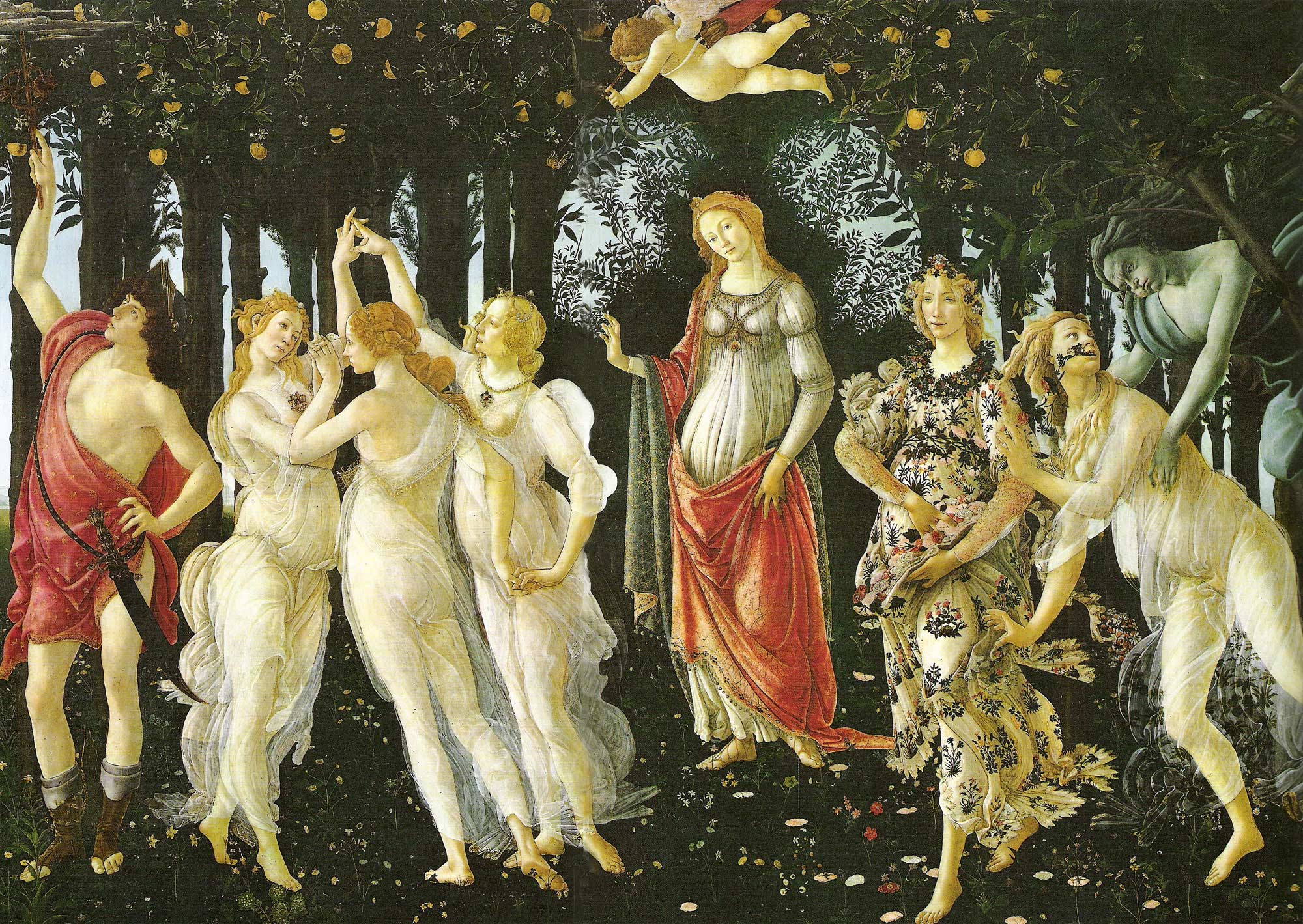
The symbol that Coleman evoked can be found throughout all of Western culture, from Macbeth's witches to Bill Paxton's wives on Big Love. We see them dancing dreamily in Botticelli's Primavera, we watch them blending and merging in Robert Altman's Three Women. In fact, countless movies and television shows feature a strong trio of women as their central characters. It's a classic story element that draws our attention like a magnet, thanks to our unconscious attraction to ancient symbols. Often the women are identical, interchangeable, or linked supernaturally in some way -- whatever it takes to present them as a unified force, a circuit.

The cover of Cat Power's recent album, Jukebox, caught my eye the other evening. I had just watched her perform at the Apollo Theater in Harlem, an event I won't ever forget. A notoriously private and troubled artist with a history of performance anxiety, Chan Marshall seemed to have put up so many barriers between herself and her public that night -- she relied heavily on cover songs (which Jukebox mainly consists of), like James Brown's "Lost Someone"; she performed in near-darkness onstage, she barely uttered a syllable between songs, she often physically retreated upstage, singing from behind her band-members. With her voice, however, she did everything possible to draw the audience in -- every song was painstakingly performed with the utmost vulnerability. And as the set progressed, the lights grew ever-so-slightly brighter and brighter, until what had begun as a cold and isolating experience became intoxicatingly intimate. By the end, when Marshall stepped down from the stage to wander the aisles and sing among the audience, there seemed to be a collective holding of breath for fear of scaring her away, like you do when a butterfly or dragonfly lands on you. As she finished the show, she threw roses to the crowd. Finally after two full hours she said goodnight; it was obvious that there would be no encore -- there was literally nothing left for her to give.

The persisting illusion that intimacy and love are only truly possible between two people runs contrary to these kinds of experiences, which are quite common in our everyday lives. The Three of Cups encourages us to share ourselves and each other, and to accept the same from others when it is offered. It is a celebration of the egolessness that can be achieved, however temporarily, through creative pursuits or any situation in which one person invites others into his or her world.

On all issues pertaining to abundance, I defer to Mother Teresa's logic: “I have found the paradox that if I love until it hurts, then there is no hurt, only more love.”


Photobucket

11.06.2008

The Four Threes


It's handy that we've already covered the Aces and the Twos. The former served as pure expressions of the elements as worlds of their own, and the latter opened each of them up to the idea of contact with other worlds, resulting in graceful, harmonious interactions.

The best way to explain the significance of Three is basic geometry. Imagine a point:


•


That's our Ace, perfectly self-contained. Now imagine a second point:


•. . . . . . . . . .•


Two represents a moment of awareness in which our point begins to recognize other points as a basis for comparison. The relationship they have is enlightening but very insular. In geometry this is expressed as a line. Now add a third point:


•

•. . . . . . . . . .•


If that second point was one of comparison, the third is a point of reference. Now that we have a triangle, the original point has an actual sense of where it exists in proximity to these others -- for example, "I am closer to c than to b." A sense of where it exists in the larger scheme of things is now possible.

This concept is a leaping-off point for understanding the Kabbalah and other mystical systems (see The Chicken Qabalah, for example, on my reading list), but I'll spare you. I don't think you have to be interested in any of that to understand how this works. I think it's a given that people's awareness grows in this fashion from childhood onward, and this third stage represents that familiar point at which one begins contemplating one's position in the wider world, becoming flooded with a sense of wonder and potential. Do you remember?

If you look at each of the cards above, they have a sort of wonderful fullness to them that isn't present in the Twos: more people are involved, greater goals aspired to, steeper risks taken. The playing field is larger, and they're all suddenly so inspired. The Three of Swords may stick out like a sore thumb thanks to its forecast of gloom and doom, but isn't that the price we pay for learning more about our place in the universe? We're thrilled to begin to see the web holding everything together, but we also become painfully aware of our vulnerability and our apparent insignificance.

Trinities abound in theology and mythology. I think it's the natural result of a simple idea becoming more complex; as civilizations grow, gods are called upon to cover more ground, taking on attributes that increasingly contradict. Once you concede to splitting your god into two figures, or allow him to take on a deputy, what's to keep from taking it further? Why not three, or seven, or seven hundred? The number three is symbolic of that tipping point into multiplicity. It gives us permission, but reminds us of the elegance of restraint.

11.03.2008

Three of Wands


We saw the conviction and authority demonstrated by the late Edith Macefield in the Two of Wands; in the Three, that show goes on the road. Think creative energy, ambitious goals, and enough confidence to bring it all off -- if you can even muster two out of those three, then chances are you're in great shape to participate in National Novel Writing Month. Between November 1st and November 30th, participants in NaNoWriMo devote a certain amount of time each day to composing a 50,000 word novel (that's about 1600 words a day, or a few pages). It doesn't have to be good -- this is a rough draft, after all, and what you do with your novel after that is purely up to you. It's just a wonderful collective source of encouragment to draw from as you cultivate a daily practice of setting your thoughts and words into motion. Last year alone over 15,000 people managed to drag their tired, sore manuscripts across the finish line!

If you currently have energy to spare, then it really doesn't matter what your life holds in the long term. It's your intentions that are important, and keeping the charge of electricity you've built up from going to waste. Take a hard look around and you may be surprised to discover that opportunities you normally wouldn't be able to muster much enthusiasm for suddenly glisten with potential. You want some homework? Apply that "I can't lose!" feeling to at least two challenges this week. If one of them turns out to be your new novel, all the better -- after all, there are still 27 days left.

10.29.2008

Three of Coins


One funny thing about the Tarot: the wrong cards hog the attention. Sure, it's fun to get all trembly over the challenges presented by Death or the Ten of Swords, but at the end of the day, wouldn't you rather have the subtle reassurances of the Three of Cups, or perhaps the Two of Wands? The card above is one of these latter, and rarely shows up as more than a blip on the radar for readers and querents alike. Perhaps it needs a stylish image overhaul -- the Waite version is a total snooze, and even the bombastic Thoth deck version looks a little phoned in (sorry Lady Frieda, but I call 'em like I see 'em).

The Three of Coins represents the satisfaction of a job well done -- the sort of coordinated effort that feels worthwhile for its own sake, yet still produces stunning results. While this may not inspire the sort of orgiastic imagery that other cards do, I've been determined to find an example that encapsulated the nuance of craftsmanship and the vision of art; something simple, ambitious, and timeless.

It's unfortunate that I only learned of designer Lou Dorfsman's work on the CBS cafeteria wall thanks to news of his passing this week, but as soon as I saw the photos I knew I'd stumbled onto something singular. The entire wall is a joyous assemblage of typefaces describing various food items, each spelled out in a handcrafted wooden letters. Dorfsman commissioned the project based on his designs, and once the first panel was complete, he passed the torch to his friend and fellow designer Herb Lubalin, who oversaw the rest of them. The finished wall was 33 feet long and 8 feet high, and entertained the cafeteria's guests for 20 years; now, having fallen into disrepair in storage, a new gang of artisans are working to restore the wall in hopes that it will find its way back into public view.

Meditating on the hundreds of hours poured into this humble piece of art over the decades is bound to make you wonder which of your projects will stand the test of time, which ones are worth your while regardless, and which ones might benefit from a little outside input. The ability to get things done the way you've envisioned them is, ultimately, an art in itself. [Via]

9.14.2008

Three of Cups


This card is so simple that a glimpse at its artwork usually tells you everything you need to know; an unprecedented bounty of fulfillment, gratitude and joy. Some decks have entitled this card "Abundance," which seems to connect the card to the Autumn harvest and the celebratory spirit that accompanies it.

This feeling of warmth and plenty is what the organization Bitone tries to instill in Ugandan children who have suffered the loss of their parents or their homes due to the myriad life-threatening issues that families face in that nation. According to their site, Bitone means "talent," which is fitting since one of their strategies is to help children and youth "heal their lives by teaching them traditional African performing arts; music, dance, folklore and theater."

Click here to listen to the children of Bitone sing "All Is Full of Love," a song by Björk (the original version has become famous for its music video, in which two robots bond emotionally despite their sterile surroundings). Their photos and songs will give you some inkling of how vital and gratifying this experience is for the displaced children of Uganda. Hopefully this card will ease you into an appreciative and joyful season of your own. [Via]

8.18.2008

Three of Swords


You may recall a previous tale I told about a lovelorn young woman committing suicide and becoming an accidental objet d'art. However, Evelyn McHale's story is somewhat different than that of the Queen of Cups. On May 1, 1947. McHale threw herself from the observation deck of the Empire State building, falling 86 stories and striking a limousine with devastating force. This photograph, snapped mere moments afterward, captured a strange serenity and beauty; the photo was published all around the world. Eventually the image was even appropriated by Andy Warhol. Apparently, the 23-year-old woman had recently left her fiancé; there was a note found in her pocketbook, though she had crossed out her own words: "He is much better off without me ... I wouldn't make a good wife for anybody."

Nothing about her torment sets McHale apart from L'inconnue de la Seine. And certainly they have both become tragic romantic icons. The most profound difference between them is that one woman chose to settle her matter privately, causing as little unnecessary pain to others as possible. The other woman was so blinded by her own grief that she transformed herself into a missile; it's only by chance that she took no one else with her (the limo driver was in a nearby store), and she forced hundreds -- maybe thousands -- of bystanders to witness her death.

The Three of Swords is perfectly apt here; the card often portrays some form of heartbreak, but this shouldn't be read as a prediction of romantic tragedy per se. Rather, it's about the vicious circle in which immense grief results in the loss of your senses, and vice versa. Sorrow pulls curtains around you; it cuts you off from the world, but it also cuts you off from yourself. What you need in order to heal might be right under your nose, but you can't see it. And meanwhile, you are still moving about in the world, blind to the anything but the pain you feel -- and this can result in even greater misfortunes, the consequences of which only perpetuate that miserable feedback-loop you're caught in.

Drawing this card may sound pretty unpleasant, but consider it an important reminder: if you suddenly find yourself in bad shape, pull yourself over and give yourself adequate time to heal, lest your impaired judgment make things more complicated. Or if you have the opportunity to counsel a friend in need, remember that trying to get them "back to normal" as soon as possible might make you feel more comfortable, but it may not do either of you any actual good at all. The easy way out usually makes life harder for everyone else involved.