


What is it about three women together? Pamela Coleman-Smith's Three of Cups was the first to use this motif, and plenty of others have continued the tradition. These scenes all broadcast both intimacy and openness; they hint at a special bond where everything is shared and all parties are supported.
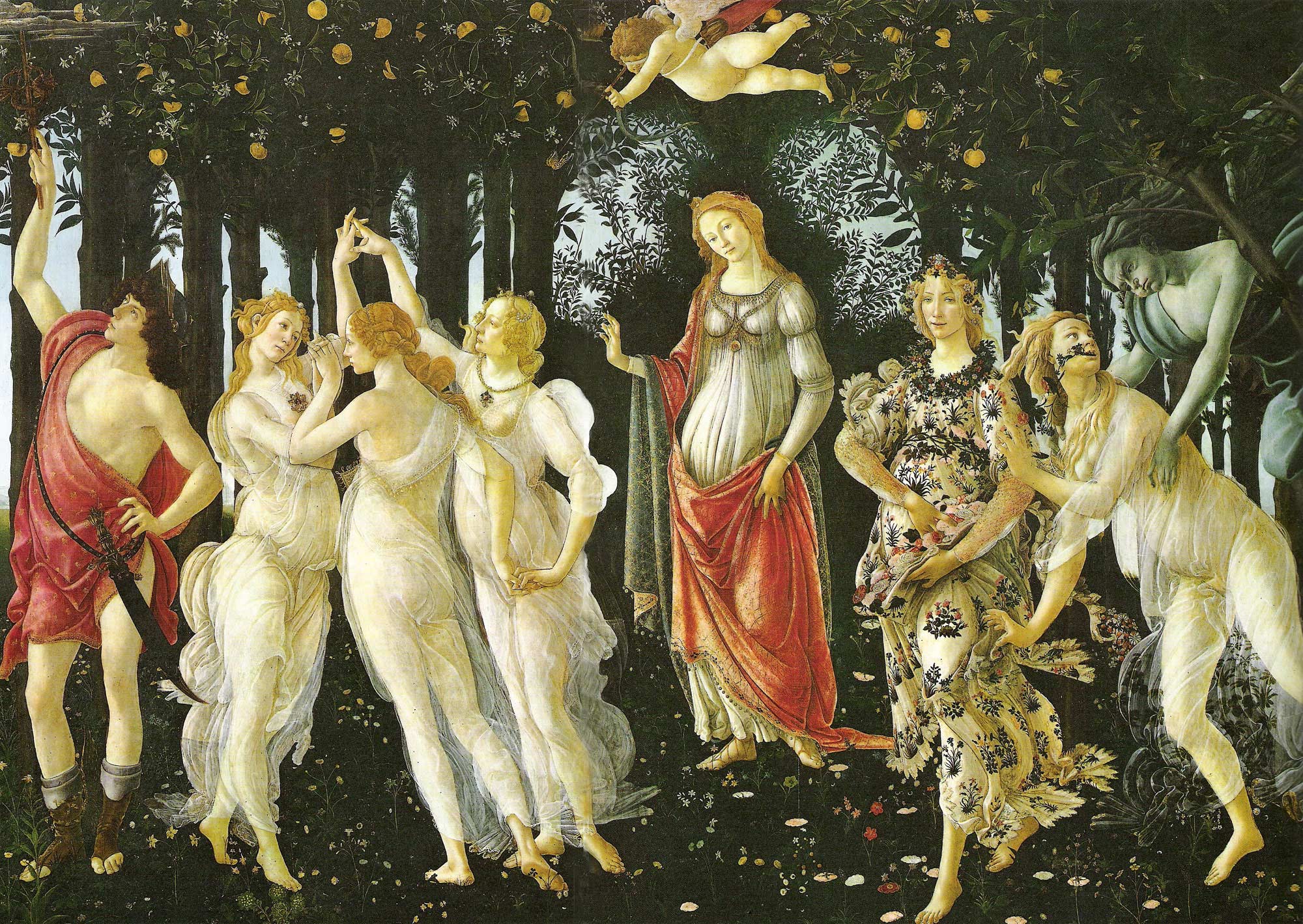
The symbol that Coleman evoked can be found throughout all of Western culture, from Macbeth's witches to Bill Paxton's wives on Big Love. We see them dancing dreamily in Botticelli's Primavera, we watch them blending and merging in Robert Altman's Three Women. In fact, countless movies and television shows feature a strong trio of women as their central characters. It's a classic story element that draws our attention like a magnet, thanks to our unconscious attraction to ancient symbols. Often the women are identical, interchangeable, or linked supernaturally in some way -- whatever it takes to present them as a unified force, a circuit.
The cover of Cat Power's recent album, Jukebox, caught my eye the other evening. I had just watched her perform at the Apollo Theater in Harlem, an event I won't ever forget. A notoriously private and troubled artist with a history of performance anxiety, Chan Marshall seemed to have put up so many barriers between herself and her public that night -- she relied heavily on cover songs (which Jukebox mainly consists of), like James Brown's "Lost Someone"; she performed in near-darkness onstage, she barely uttered a syllable between songs, she often physically retreated upstage, singing from behind her band-members. With her voice, however, she did everything possible to draw the audience in -- every song was painstakingly performed with the utmost vulnerability. And as the set progressed, the lights grew ever-so-slightly brighter and brighter, until what had begun as a cold and isolating experience became intoxicatingly intimate. By the end, when Marshall stepped down from the stage to wander the aisles and sing among the audience, there seemed to be a collective holding of breath for fear of scaring her away, like you do when a butterfly or dragonfly lands on you. As she finished the show, she threw roses to the crowd. Finally after two full hours she said goodnight; it was obvious that there would be no encore -- there was literally nothing left for her to give.
The persisting illusion that intimacy and love are only truly possible between two people runs contrary to these kinds of experiences, which are quite common in our everyday lives. The Three of Cups encourages us to share ourselves and each other, and to accept the same from others when it is offered. It is a celebration of the egolessness that can be achieved, however temporarily, through creative pursuits or any situation in which one person invites others into his or her world.
On all issues pertaining to abundance, I defer to Mother Teresa's logic: “I have found the paradox that if I love until it hurts, then there is no hurt, only more love.”
2.09.2009
"There Is No Hurt, Only More Love..."


Subscribe to:
Post Comments (Atom)


I needed this today. Thanks.
ReplyDelete